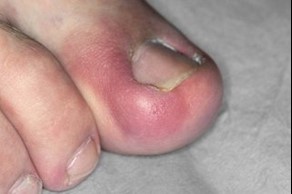
An ingrown toenail occurs when the edge of the toenail grows into the surrounding skin, causing pain, swelling, and sometimes infection. It most commonly affects the big toe, but it can occur on any toe, and can make day to day activities uncomfortable.
If untreated, an ingrown toenail can become severely painful and lead to more serious complications such as infection.
Why does this happen?
There are many reasons this can occur including:
Improper Toenail Trimming: Cutting your nails too short or cutting into the corners of the nail can lead to ingrown toenails.
Excessive Sweating/Moisture: The skin surrounding the toenail(s) softens and increased the risk of toenail growing into the skin.
Tight Fitting Footwear: Shoes, socks or hosiery that is too tight can cause the toenail to grow into the surrounding skin.
Injury: Trauma to the toe, such as stubbing or pressure from our footwear can increase the risk on an ingrown toenail.
Nail Shape: Nails that are broad, curved or thickened can increase the risk of ingrown toenails.
How can I prevent this?
There are things you can do to prevent an ingrown toenail as part of your personal footcare routine. Further information and support available from our personal footcare site.
Important points to remember:
Ensure you are using the appropriate equipment and technique when cutting your nails. Cut nails straight across and avoid cutting them too short. Nail files are useful for maintaining nail length and smoothing any rough edges.
Good hygiene is essential (including hoisery). Washing and drying your feet properly can reduce risk of infection and reduce skin irritation.
It is important that your footwear is well fitting, with enough room for your toes. Avoid shoes that press your toes together.
What do I do if I have an ingrown toenail?
For mild cases of ingrown toenails, the following methods may be effective:
Bathing In Salt Water: Warm water in a clean basin with ordinary table salt can sooth the symptoms of ingrown toenails and keep the affected toe(s) clean.
Correct nail cutting: Trimming your nails straight across and avoiding cutting into the edges can help the condition from worsening
Over-The-Counter Medication: Pain relief, paracetamol or ibuprofen.
Podiatry Treatment: If the ingrown toenail does not resolve, becomes more painful, persistent or infected, Podiatry treatment is advised. Details on how to make an appointment are below.
What will happen at my initial appointment?
At your initial podiatry appointment, your safety is paramount. Therefore, we will take a history of any long term health issues or medications to make sure that any management options discussed are suitable for you.
We may be able to resolve the problem at that initial appointment, however, in some cases you may need further treatment which may require a local anaesthetic. We will discuss all your treatment options and will refer you for nail surgery if agreed and appropriate. We will discuss with you the benefits, the risks and the alternative options which will give you the opportunity to voice any concerns you have so you can make an informed choice of your management plan.
We can arrange for antibiotics if they are required. You may be supplied them by the podiatrist or have them requested by you GP.
Nail Surgery
What is nail surgery?
If we have not been successful in managing your problematic nail conservatively, then we can refer you for nail surgery.
What will happen at my nail surgery appointment?
Again, you will have the chance to ask questions and voice any concerns. We will not proceed without your consent and you are free to decline treatment on the day if you change your mind.
The procedure is performed under local anaesthetic which will numb the affected toe(s). This allows us to safely remove the full nail, or part of the nail depending on what was decided during the discussions. A chemical is then applied to the nail bed to prevent a portion or full nail from regrowth. This is a permanent solution which will reduce the chances of regrowth.
A family member/friend may accompany you to your appointment for support if needed.
Preparing for the appointment
Ensure you have breakfast/lunch depending on the time of your appointment
Bring open toe shoes (sandals, flip flops etc.) to accommodate the dressing that will be applied
Ask of family member/friend to drive you or consider public transport. If this is not possible you may drive
Ensure you are able to rest the foot following the procedure. The Local anaesthetic will wear off in approximately 2-3 hours, take care not to damage it while it is numb.
Aftercare and what to expect
We will discuss with you how best to look after your toe after your nail surgery procedure and provide written advice. You will be provided with a small supply of dressing and advised where you can source more dressings.
We will discuss expected healing times at the appointment. This can vary depending on any underlying health issues which may affect the rate of healing but could be anything up to 12 weeks.
It is important to monitor the are for sign signs and symptoms of infection -such as redness, increased swell or pain- and again, we will go through all this at the end of your appointment and allow you to ask any questions you may have
You can self-refer to NHS Greater Glasgow & Clyde podiatry by contacting NHSGGC Podiatry Referral Management Centre:
You will initially be given a telephone triage appointment, where you will have a consultation with one of our highly skilled podiatrists. Depending on the severity of your problem, they make any appropriate referrals or appointments as required.
Was this helpful?
Yes
No
Thanks for your feedback!
‘Get Ready For’ programme
Ready to consider the future? Could Podiatry be the career for you?
Stay curious and join us on the NHS Greater Glasgow and Clyde Get Ready for Podiatry programme to find out more.
The NHS Greater Glasgow and Clyde Get Ready for Podiatry programme is a timetabled opportunity delivered by the NHS Greater Glasgow and Clyde Podiatry Service in collaboration with Higher Education Institutions and offers a hybrid experience to explore Podiatry as a profession.
This programme will offer a unique work experience opportunity for all who are considering Podiatry as a career option whether this be as a qualified podiatrist returning to practice, a school leaver or mature student.
Please click on this link for more information on our ‘Get Ready For’ programme
Practice based learning in podiatry
The Podiatry Service offers an innovative and soundly governed Practice Based Learning (PrBL) programme. We utilize a blended learning provision which is centred on a Peer Assisted Learning (PAL) model. We aim to engage students in a programme of meaningful clinical thinking with the objective of maximising their capabilities and confidence within clinical decision making whilst delivering optimal person centred care.
Over the course of an academic year, we offer in excess of one thousand placement weeks. Placements are offered to both institutes in Scotland offering entry qualifications into Podiatry. The two institutions offering Podiatry at undergraduate level are Glasgow Caledonian University (GCU) and Queen Margaret University . Various options of study are available depending upon eligibility criteria being met.
As the primary PrBL provider for the GCU Podiatry programme, we host Level 1 to Level 4 students at the Department of Podiatry, Queen Elizabeth University Hospital (QEUH) throughout Trimester A and Trimester B which acts as our placement hub. Block placements occur during Trimester A, B and C within the single service seperate from our placement hub.
Additionally, as the need for PrBL placements for all AHP professions increase, we aim to explore new and innovative methods of offering cross-profession PrBL opportunities through both face-to-face and digital platforms.
The Podiatry Service works collaboratively with its academic colleagues ensuring alignment to learning outcomes with quality underpinning every placement hour.
We are keen to hear the voice of the student and their experience at the end of each placement. Using a student-based audit enables an understanding of what worked and what didn’t to inform changes to the PrBL programme.
Return to Practice
The Podiatry service offers an excellent opportunity for podiatrists who wish to return to podiatry practice and require to re-register with the Health and Care Professionals Council (HCPC). Our fully funded learning programme will support you in your return to practice. Candidates who successfully achieve registration will be eligible to apply for Band 5 posts within NHS Boards.
We offer a structured development opportunity to support and consolidate knowledge, skills and competence in supportive learning environments. Your individual learning and support framework will have full mentorship from our team of practice educators and practice development.
In this post you will:
Have the opportunity to provide podiatric care in a variety of clinical environments. You will be supported by your mentor using various supervisory methods.
Provide a high level of both palliative and corrective care as outlined in the agreed management plan.
Liaise with or referring to other Health Care Professionals (HCPs) or Agencies as appropriate.
Plan and organise own workload to ensure effective caseload management of a diverse range of patients
Knowledge, Experience and Qualifications
You must hold a BSc (Hons) Podiatry or Diploma in Podiatry and will be required to complete a period of supervised practice. The length of supervised practice will be detailed by the HCPC Returning to Practice Requirements. You will demonstrate the ability to work as part of a team. Evidence of prioritisation, planning and organisation of workload are essential.
Roles and Responsibilities
You will create a portfolio to showcase your learning and development.
Adapt your learning needs through reflective practice and feedback to develop professional knowledge and skills.
Read and understand the HCPC Standards of Proficiency.
We offer this opportunity on a fixed term basis and will accommodate the return to practice requirement of the applicant. There is flexibility across whole and part time working.
For initial discussion please contact Julie Braidwood on Julie.Braidwood@nhs.scot or Pamela Price on Pamela.Price@nhs.scot
The PREPARE project
What is PREPARE?
The Pre Registration Podiatry: Accessible Recruitment & Employment (PREPARE) Project is an innovative approach to growing our workforce by enabling people into the profession of Podiatry. The service employs PREPARE trainees on an annex 21 basis to undertake a BSc (Hons) in Podiatry. PREPARE Trainees receive full employee benefits as per Agenda for Change terms and conditions.
How does PREPARE work?
The Podiatry Service has an agreement with Glasgow Caledonian University (GCU) which has condensed the teaching timetable to three full days, instead of spreading it over five days. This is in line with student feedback across the institution and would benefit the student experience. There is no change to programme or module learning outcomes. PREPARE Trainees have dedicated time to engage within the academic content up to 3 days per week with the remaining 2 days being specified by service led duties. Trainees engage in service-led duties 5 days per week during non term time.
Why is PREPARE needed?
Through widening access to those who are not able to leave full time employment to access adult learning opportunities we believe this novel approach to meeting the workforce challenges stands to safeguard frontline Podiatry services in NHSGGC for the intermediate and long term future. Investment in ‘Earn to Learn’ schemes enhance graduate capability by providing integration across service delivery which enables extensive clinical exposure, whilst undertaking graduate level study.
Continuation of employment to a Band 5 Podiatrist is subject to successful completion of the BSc (Hons) Podiatry and Health & Care Profession Council (HCPC) registration. For the Health Board, these graduates will have extensive clinical experience, alongside a detailed knowledge of policies and procedures. The Podiatry service will employ 4 PREPARE trainees per academic year from 2023 to 2027.
To hear from a PREPARE Trainee and their experience, please click on this link to view the video
Was this helpful?
Yes
No
Thanks for your feedback!
Podiatry provide assessment, management and foot health education to individuals with conditions affecting the lower limb, enabling self-care and self management where possible. We have highlighted some of the most common problems below and created resources which you might find helpful in supporting your foot and lower limb health issue.
Please note: NHS Inform is also a helpful resource.
Making an appointment
If you feel you need to speak to a podiatrist, then the details on how to do this are outlined below. It is likely that your first contact will be by telephone so we can triage you appropriately to best support your needs. Our consultations are delivered in various ways, including telephone, video, group education as well as face to face.
Podiatry does not provide personal footcare. Please refer to the ‘Personal Footcare’ resource above.
At the Specialist Weight Management Service (SWMS), patients are encouraged to take a realistic approach to weight loss. We want to challenge the notion of ‘going on a diet’. Unlike some fad diets, SWMS is based on current expert opinion and research evidence. Patients are asked to explore not only what they eat, but also when they eat, why they eat and how they eat.
SWMS encourage dietary and lifestyle changes that are realistic, achievable and that can be sustained in the long-term. The focus is improvement in health, through healthy eating and realistic weight loss, rather than striving for the perfect figure or an ideal bodyweight.
Lifestyle Intervention
The 12 week programme made up of 7 fortnightly sessions. Each session lasts 1.5 hours which covers information and support on diet, activity, and behaviour change strategies.
A Personalised Dietary Prescription (PDP,) is calculated based on height, gender, age, weight and level of physical activity. The Eatwell Guide outlines a healthy, nutritionally balanced diet that allows for personal food choices.
The minimum target weight loss in the lifestyle intervention phase is 5-10kg (11.5 lbs to 1.5 stone). This equates to a steady weight loss of 0.5-1kg (1-2 lbs) a week.
Dietary topics covered include:
The Eatwell Guide and portion control
Regular meals and planning
Eating out and takeaways
Practical tips and recipes
Shopping and food labelling
British Dietetic Association (BDA) statement on low or no calorie sweeteners
Expert scientists representing the BDA, the British Nutrition Foundation and Diabetes UK have collectively produced a position statement outlining the safe use of low or no calorie sweeteners, when consumed within acceptable daily intakes.
Evidence shows that the use of approved low or no calorie sweeteners may support a reduction in free sugar intake, weight management and blood glucose control, however their use should not be the primary dietary intervention.
All About Obesity provides education, information, support and advocate for those living with obesity.
Better Health
Better Health offers information to kickstart better health for you.
PCOS (Polycystic Ovary Syndrome)
Polycystic Ovary Syndrome (PCOS) is a common complex hormonal condition which affects how the ovaries work. Lifestyle choices such as the type and amount of food you eat, as well as the activity you do, can improve symptoms.
Self monitoring using online apps are becoming more popular. They are a quick and convenient way to assess and track dietary intake. You can download apps on your smart phone – some of which are free and very easy to use. Some commonly used dietary apps are listed below.
Nutracheck (calorie counter +)
Nutracheck (calorie counter +) provides food and exercise tracking, UK food database with over 250,000 products with photos (verified data), scans barcodes, links with Apple Health. This app has a fee and is approved by ORCHA.
MyFitnessPal
MyFitnessPal provides food and exercise tracking, barcode scanner, large food database with over 6 million foods including restaurants menus. The app can connect with popular apps and devices such as – Garmin, Strava, Runkeeper, Fitbit. The app allows you to share your progress with friends and is free.
Lifesum
Lifesum is a food and exercise tracking app. The ‘basic’ plan (food and activity diary,) is free, however, you would need to pay a monthly subscription fee to access healthy recipes, sync the app with health apps, etc.
LIVA
LIVA is an integrated digital platform for disease management and lifestyle change. The app allows you to monitor physical activity, sleep, mood and dietary intake. Users can also record biometric parameters e.g. blood sugar levels, blood pressure, lung function.
Designed to provide support and guidance for people at risk or living with chronic diseases such as Obesity, pre and type 2 diabetes, hypertension. This app is free and approved by ORCHA.
Easy Meals
The Easy Meals app is free and provides over 150 easy, calorie counted recipes across breakfast, lunch and evening meals and puddings. The app also has a handy shopping list to make planning and shopping easier.
Change4life Smart Recipes
Change4life Smart Recipes allows you to search over 160 easy, calorie-counted recipes, easy to follow instructions and all the ingredients you’ll need to feed a family of 4 for around £5, create a shopping list, tips on how to make healthier choices.
Change4life Food Scanner
Change4life Food Scanner is an easy to use food scanner designed to help you make healthier food and drink choices. Barcode scanner will show you the total sugar and saturated fat contents of foods.
Carbs and Cals app
The Carbs and Cals app helps people control their diabetes and weight. The app contains over 3,500 food photos to help you manage your calorie intake and portions. The Carbs and Cals app also provides useful nutritional information such a carbohydrate, fat and fibre content of foods. This app has a fee.
The prevention and control of infection throughout healthcare is everyone’s responsibility and is a major component in the drive towards a safer NHSScotland.
These Standards are one part of the drive for a safer NHSScotland, so should be seen as complementary to HAI and patient safety work undertaken by other bodies, e.g. Scottish Patient Safety Programme (SPSP). These Standards for HAI apply to all healthcare environments in which patients are treated.
GIRFEC – Getting It Right For Every Child is the national approach in Scotland to improving outcomes and supporting the wellbeing of our children and young people by offering the right help at the right time from the right people. It supports them and their parent(s) to work in partnership with the services that can help them.
At NHSGGC we have a key role to play, whenever we come into contact with children and young people – whether we are caring directly for them, or other members of their family or household. Where extra support is needed, the GIRFEC approach aims to make that support easy to access and seamless, with the child at the centre.
GIRFEC Frequently Asked Questions – start here for answers to the most commonly asked questions about Getting it right for every child
Please read the following information and then use the links at the bottom of the page if you are looking for further information or exercise.
Important information to read if you have any concerns about your foot/ ankle pain
Please click below to expand relevant section; these sections outline some of the main issues that we would advise you get checked by a health professional before commencing self-management exercises. These are called Red Flags and may indicate a more serious problem that requires medical assessment.
Symptoms that are present After Trauma
If your symptoms are caused by a recent traumatic incident (e.g. a fall, football tackle) and you have any of the following symptoms:
Extensive bruising and/ or swelling
Discolouration e.g. your foot looks pale, blue or red
Severe pain and very limited movement
Joint deformity eg foot looks like it is in the wrong place
New lumps and bumps that appear after the trauma
Great difficulty putting weight through your leg
Numbness/ tingling into your foot after trauma
Feeling of instability
Please Note: If you have a known diagnosis of osteoporosis (low bone density) a small amount of force may cause problems that require medical assessment.
Symptoms where No Trauma was Involved
Sudden loss of active movement with or without pain
Redness, heat and swelling of the joint/ surrounding area
Increasing numbers of joints that are painful and/or stiff
Fever or generally feeling unwell at same time as your foot pain developed
Unexplained numbness/ tingling into your foot
Constant pain which does not change with rest or activity
Significant worsening pain at night
Unexplained weight loss and/ or a previous history of cancer
Unexplained lumps and bumps that appear or are changing/ growing
Difficulty lifting the front part of your foot/ catching or dragging your foot when walking
Please Note: Special attention should be taken if you have a history of long-term steroid or immunosuppressive drug use, recent joint replacement, recent steroid injection, rheumatoid arthritis or other joint disease, recent infection, Intravenous drug use or alcohol misuse.
Our colleagues in the NHS Greater Glasgow and Clyde Podiatry team have developed a range of information resources for specific foot conditions – see what resources are available.
Foot and Ankle Exercises
Please make sure you have read through the important information about foot pain before proceeding.
Here are some beginner-to-progressive exercises to help you get your foot/ankle moving better. You may need to build these exercises up gradually.
You may be uncomfortable when you start doing these exercises – make sure the level of discomfort feels acceptable to you and that it doesn’t take too long to settle once you are finished.
The exercises should get easier the more consistently you manage to practice them and this may allow you to progress to more difficult exercises.
These are self help exercises:
Try to enjoy the exercises and work at a pace and level that feels safe.
Please use a common sense approach when deciding which ones to try.
The exercises listed are not designed as an alternative to professional advice.
We use cookies to analyse traffic to our site and to enable certain functions such as forms and YouTube videos. These do not collect personal information. By clicking "Accept All", you consent to our use of cookies, or you can customise the options.
This website uses cookies
Websites store cookies to enhance functionality and personalise your experience. You can manage your preferences, but blocking some cookies may impact site performance and services.
Essential cookies enable basic functions and are necessary for the proper function of the website.
Name
Description
Duration
Cookie Preferences
This cookie is used to store the user's cookie consent preferences.
30 days
CloudFlare provides web performance and security solutions, enhancing site speed and protecting against threats.
Sequence rules uses cookies to track the order of requests a user has made and the time between requests and makes them available via Cloudflare Rules. This allows you to write rules that match valid or invalid sequences. The specific cookies used to validate sequences are called sequence cookies.
session
cf_ob_info
The cf_ob_info cookie provides information on: The HTTP Status Code returned by the origin web server. The Ray ID of the original failed request. The data center serving the traffic
session
cf_chl_rc_m
These cookies are for internal use which allows Cloudflare to identify production issues on clients.
session
__cfruid
Used by the content network, Cloudflare, to identify trusted web traffic.
session
__cf_bm
Cloudflare's bot products identify and mitigate automated traffic to protect your site from bad bots. Cloudflare places the __cf_bm cookie on End User devices that access Customer sites that are protected by Bot Management or Bot Fight Mode. The __cf_bm cookie is necessary for the proper functioning of these bot solutions.
session
__cflb
When enabling session affinity with Cloudflare Load Balancer, Cloudflare sets a __cflb cookie with a unique value on the first response to the requesting client. Cloudflare routes future requests to the same origin, optimizing network resource usage. In the event of a failover, Cloudflare sets a new __cflb cookie to direct future requests to the failover pool.
session
_cfuvid
The _cfuvid cookie is only set when a site uses this option in a Rate Limiting Rule, and is only used to allow the Cloudflare WAF to distinguish individual users who share the same IP address.
session
cf_clearance
Whether a CAPTCHA or Javascript challenge has been solved.
session
cf_use_ob
The cf_use_ob cookie informs Cloudflare to fetch the requested resource from the Always Online cache on the designated port. Applicable values are: 0, 80, and 443. The cf_ob_info and cf_use_ob cookies are persistent cookies that expire after 30 seconds.
session
__cfwaitingroom
The __cfwaitingroom cookie is only used to track visitors that access a waiting room enabled host and path combination for a zone. Visitors using a browser that does not accept cookies cannot visit the host and path combination while the waiting room is active.
session
cf_chl_rc_i
These cookies are for internal use which allows Cloudflare to identify production issues on clients.
session
cf_chl_rc_ni
These cookies are for internal use which allows Cloudflare to identify production issues on clients.